usaciv

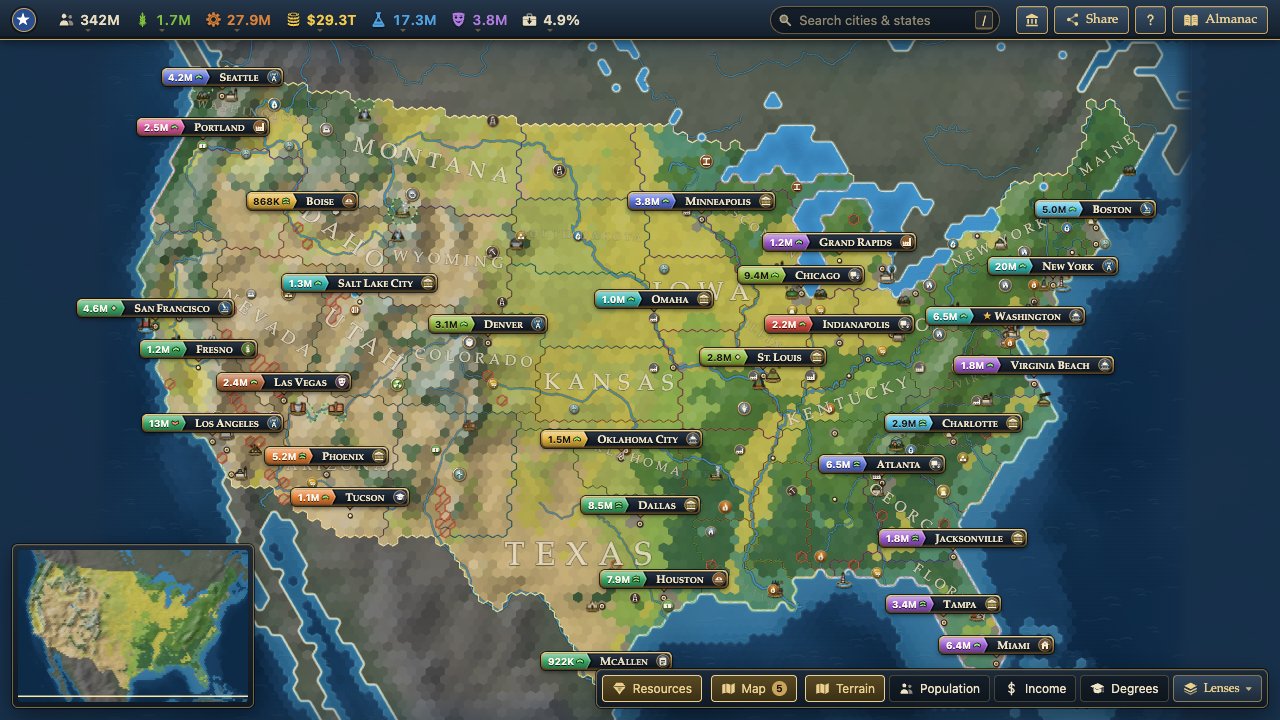
The real United States drawn as a Civilization-style hex map, built from 31 public data sources.

See it live
The United States as a strategy-game map screenshot

What it is

Andrej Karpathy asked Claude to fill a Civilization-style strategy map with real data about the United States. Working in the Claude Code desktop app with Opus 5.5, Claude downloaded and parsed public data from 31 sources, including the Census, BEA, NOAA, USGS and EIA, and fit it onto one hex grid with cells about 25 km across.

It is a map to explore, not a game. GDP shows up as gold, jobs by industry become the other yields, and real power plants, mines, ports, bases and national parks sit on the tiles. Click a city to see its citizens and districts. He says it took about 7 hours and about 45,000 lines of code.

What went wrong

Claude left out a few states and territories on its own, and Karpathy said so himself when he shared it. The map covers the lower 48.

What we learned

Karpathy says it could be expanded or turned into a real game, and he shares the full source as a zip so someone else can pick it up. The data pipeline uses plain Python and public downloads that need no API keys.

Comments

    More to see

    Games / 2D

    The Great Refinery Run

    A refinery engineer turned his job into a browser game to explain it to his kids.

    Taylor Bloomquist · shared by creatingwith.ai

    Games / 2D

    Kara and the Primal Torch

    A 90s-style pixel platformer where your torch is your weapon and your only light, so every shot dims the world.

    Egobiian · shared by creatingwith.ai

    Apps and tools

    Shorthand

    A text expander for the Mac that brings your TextExpander library with it.

    John Kirker

    Join the conversation

    Log in or create a free account to comment and rate. We'll email you a code, so there's no password to remember. You must be 13 or older.

    The newsletter

    New things people made with AI, in your inbox.

    Games, tools and little sites, each with the story of how it was made: what went wrong, and the prompt that worked.